Case Author(s): Yonglin Pu, M.D., Ph.D., Robert J. Gropler,M.D. , 04/08/03 . Rating: #D3, #Q4
Diagnosis: Myocardial Ischemia
Brief history:
89 year old woman with chest pain.
Images:
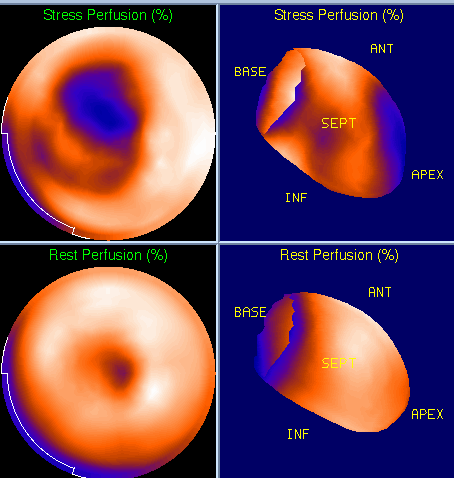
Myocardial Perfusion Imaging (Bull's Eye)
View main image(mi) in a separate image viewer
View second image(mi).
Myocardial Perfusion Imaging (Spect slices)
View third image(an).
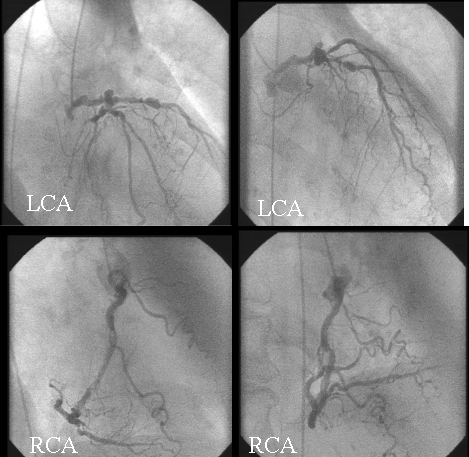
Coronary Arterograms
Full history/Diagnosis is available below
Diagnosis: Myocardial Ischemia
Full history:
89-year-old woman with chest pain. Risk factors include hypertension, high cholesterol, and post-menopausal status. This study is requested to evaluate for ischemia. The electrocardiogram during infusion of the pharmacologic agent today was negative for ischemia.
Findings:
Standard myocardial perfusion images were obtained after resting injection of Tl-201. Subsequently, an intravenous infusion of adenosine was performed under the supervision of attending staff from the Cardiovascular Division. At the peak effect of the drug, Tc-99m sestamibi was injected intravenously and standard myocardial perfusion images were obtained.
There is an extensive area of marked in severity reversible perfusion defect involving the anterior, anteroseptal, apical, and inferoapical walls of the left ventricular myocardium, consistent with myocardial ischemia. Gated Tc-99m sestamibi images demonstrate transit ischemic dilation of left ventricle (TID)suggestive of multiple vessel coronary artery disease. There is hypokinesis of the anterior and anteroapical walls. The left ventricular volume is mildly enlarged and the left ventricular ejection fraction is reduced at 33%.
Discussion:
The presence of reversible perfusion defects in multiple vascular territories combined
with transient dilation of the left ventricle (TID) during stress myocardial perfusion imaging represents a high risk study, suggesting significant coronary artery disease. In particular, transient ischemic dilation has a very high specificity for severe and extensive coronary artery disease.
References
1. Hansen et al. Comparison of Pulmonary Uptake with Transient Cavity Dilation after Exercise Thallium-201 Perfusion Imaging. J Am Coll Cardiol 1999;33:1323-7.
2. Weiss et al. Transient Ischemic Dilation of the Left Ventricle on Stress Thallium-201 Scintigraphy: A Marker of Severe and Extensive Coronary Artery Disease. J Am Coll Cardiol 1987;9:752-9.
Followup:
Coronary arteriography on next day demonstrate Severe three vessel coronary artery disease.
1. The left main coronary artery has approximately 30% diffuse eccentric narrowing due to a calcified plaque along its superior aspect.
2. The left anterior descending coronary artery is heavily calcified and diffusely irregular. There is high grade focal narrowing in the proximal portion of this vessel with aneurysmal dilatation just beyond the narrowed segment. There is competitive filling of the apical portion of the left anterior descending artery.
3. The circumflex coronary artery is a non-dominant vessel of moderate size. This vessel is also heavily calcified. There is approximately 80% narrowing in the proximal portion of the major, bifurcating marginal branch. The continuation of the circumflex is small.
4. The right coronary artery is a dominant vessel of moderate size. This vessel is also heavily calcified. There is approximately 60% narrowing just beyond the origin of the second right ventricular branch and 80% narrowing proximal to the bifurcation. The right coronary artery also fills the distal third of the left anterior descending vessel in a retrograde fashion.
ACR Codes and Keywords:
References and General Discussion of Myocardial Imaging (Anatomic field:Heart and Great Vessels, Category:Organ specific)
Search for similar cases.
Edit this case
Add comments about this case
Return to the Teaching File home page.
Case number: mi025
Copyright by Wash U MO